
A recent research of AI cheating in interviews by Fabric showed almost 40% of candidates to be cheating in interviews. How are so many candidates cheating in interviews, and what are HR teams doing to stop them?
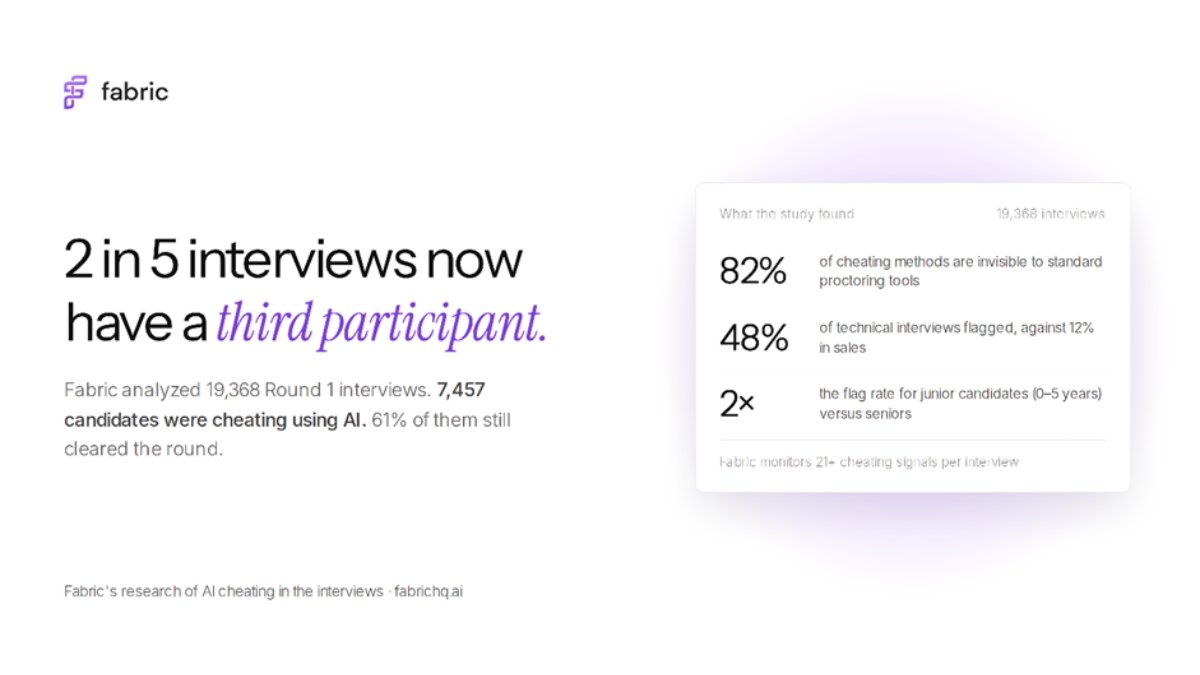
Bengaluru (Karnataka) [India], August 24: Fabric, an agentic AI hiring platform, has published an analysis of 19,368 Round 1 interviews conducted on its platform. Across that set, 7,457 candidates, 38.5% of the total, were flagged for using AI during the interview.
But there’s something more alarming for the talent leaders. Of all the candidates caught cheating in interviews, more than 61% were able to clear their tests. Which means, if there was no cheating detection in place, they would have advanced to the next round.
Abhishek Vijayvergiya, co-founder of Fabric, spoke about how this is becoming a big headache for hiring teams.
“We are seeing a lot of HR teams being alarmed about this. Just yesterday, I was speaking with the CHRO of a large IT services company in Mumbai. He mentioned that a candidate cleared all their virtual rounds and joined a client facing project. But within a week, their customer raised an escalation.
The candidate completely failed on the customer project and showed no skills that he was rated highly for during the interview. I’m hearing similar stories in almost every customer conversation.”
Fabric’s platform is used by 100+ hiring teams to conduct AI interviews. When the team did research of AI cheating in the interviews to check the prevalence of cheating in interviews, the results were shocking.
What the study found
- Fabric flagged 38.5% of candidates for AI-assisted cheating behavior across 19,368 interviews.
- 61.1% of flagged candidates cleared the pass threshold. Without cheating detection, they would have advanced to the next round.
- Technical roles showed a 48% cheating rate, against 12% for sales roles. This shows that cheating is more prevalent in tech roles compared to non-tech roles like sales.
- Junior candidates (0 to 5 years of experience) were flagged at nearly double the rate of more experienced candidates. Campus and early-career funnels carry the highest risk of cheating.
What AI Interview Cheating Actually Costs Companies
For IT services and staffing companies, the damage shows up in submission quality. These companies only get so many shots at putting a profile in front of a client, and every wrong profile erodes the trust of their customers.
This is not a rare scenario specially for tech roles. Technical roles were flagged in 48% of sessions, and 61% of those flagged candidates still scored above the pass bar.
The cost is different for enterprises hiring 50 or more people a month. Their cost is panel hours.
Screening and interviews already account for more than 60% of time in the final time-to-hire metric. Every candidate who clears Round 1 without being caught for cheating becomes a drain on senior engineers or the business time spent in Round 2.
But perhaps the most stark cost accrues when companies do bulk or campus hiring. The Fabric report found that cheating was most prevalent in junior roles. Incidentally, these are also the roles where the number of interview rounds are fewer, considerably increasing the risk of a cheating candidate passing all the rounds without detection.
How Candidates Are Getting AI Help in Interviews
The study found different methods that candidates were using for cheating:
- 45% used a dedicated interview assistant such as Cluely, typically a $50 to $150 monthly subscription.
- 34% used chatgpt voice mode or similar general-purpose large language model.
- 18% used older tricks such as tab switching.
- 3% had live help from another person off camera.
None of the cheating methods requires much effort or money. Most of these tools cost less than a lunch and run quietly in the background while the interview happens.
The tab switching is the only cheating method that most proctoring tools are built to catch. The other 82% – dominated by AI powered cheating tools – are the new norm and most hiring teams don’t have an answer for it.
How can Hiring Teams detect Cheating in Interviews?
Three things recruiters can watch for during interviews to spot potential cheating:
1. Watch for these unusual behavioral patterns.
Look for long or repeated delays before answering, repeatedly looking in the same direction as if reading from another screen, or repeatedly using the same keywords and phrases across answers. One signal alone may not mean much, but repeated patterns can indicate that a candidate is relying on external help.
2. Dig deeper with personal and follow-up questions.
AI-generated answers often sound generic and lack specificity, personal stories, and natural flow. Ask candidates questions about their own experience, resume, and previous answers, then follow up. Genuine candidates can usually build on their answers naturally, while AI-assisted responses may become vague, repetitive, or disconnected when pushed beyond the initial answer.
3. Use AI to detect what humans can’t reliably watch for.
Recruiters can’t manually track every behavioral and conversational signal across every interview. Tools like Fabric analyze 21+ cheating signals, including AI-generated answers, AI cheating tools such as Cluely and Parakeet AI, and other forms of external assistance. Fabric also automates the Round 1 interview, helping teams conduct cheating-proof interviews at scale.
How Fabric Ran This Study
The dataset covers 19,368 Round 1 interviews conducted on the Fabric platform in a 6 month duration. A session was flagged when the platform’s cheating probability crossed a certain threshold. The pass cutoff used for the scoring comparison was 7 or higher on a 10-point scale.
The detection is built to surface AI-assisted behavior with timestamped evidence so a recruiter can weigh it themselves. It is a signal for the hiring team, not an automatic reject. All final calls regarding cheating are made by the hiring team after reviewing the report – no candidate is automatically rejected based on cheating by Fabric.
What is Fabric?
Fabric is an agentic AI platform for end-to-end hiring, built for staffing companies and enterprises hiring at scale.
Fabric offers different AI agents for hiring. This includes a sourcing agent to find the best candidates, an outreach agent for candidate outreach, and interview agents to conduct round 1 interviews.
The interview agents have built-in cheating detection to help companies hire fairly. Fabric also has multiple India-specific hiring features, including interviews in Indian voices, whatsapp integration, and TRAI-compliant AI calling agents.
If you object to the content of this press release, please notify us at pr.error.rectification@gmail.com. We will respond and rectify the situation within 24 hours.